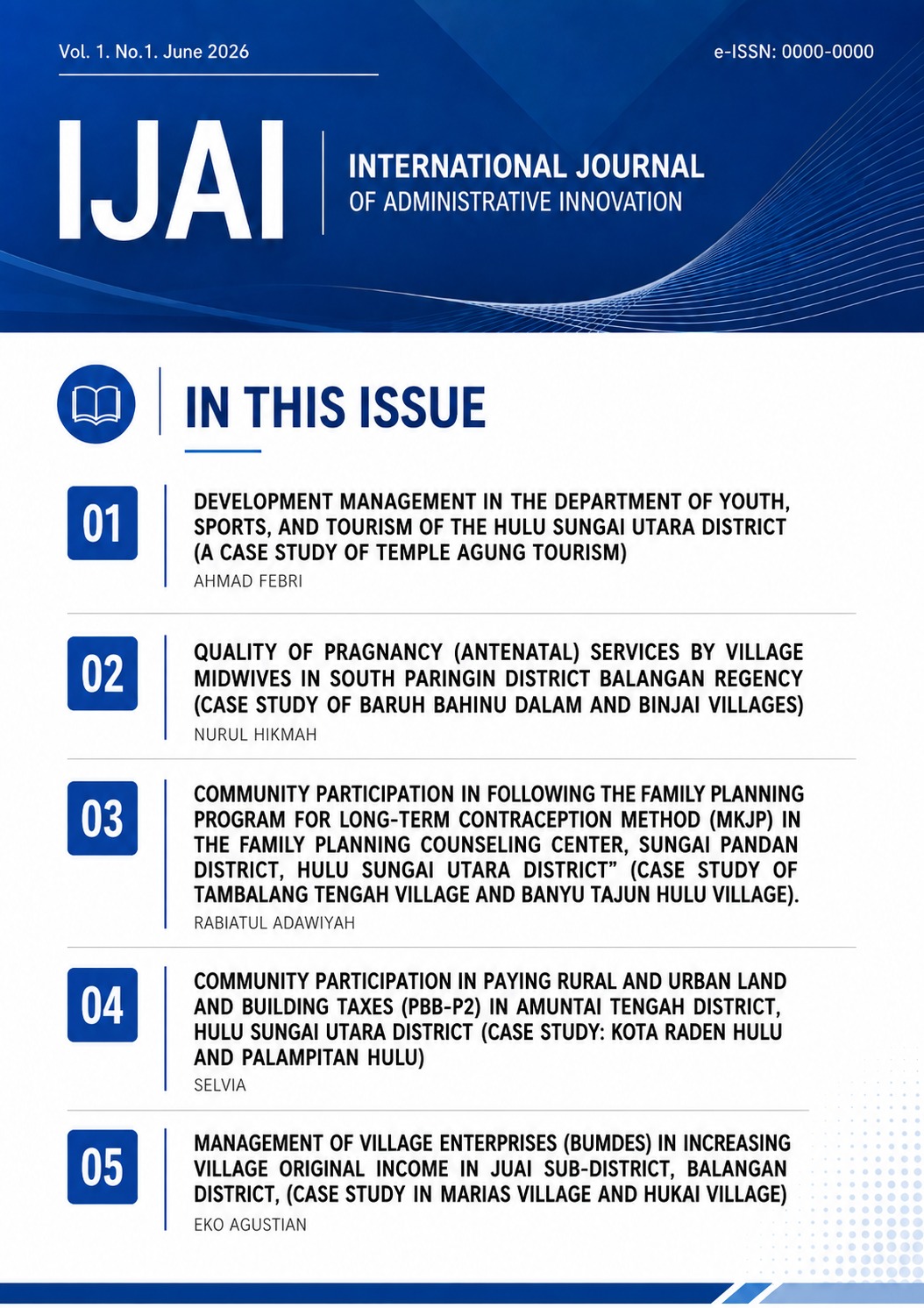
COMMUNITY PARTICIPATION IN PAYING RURAL AND URBAN LAND AND BUILDING TAXES (PBB-P2) IN AMUNTAI TENGAH DISTRICT, HULU SUNGAI UTARA DISTRICT (Case Study: Kota Raden Hulu and Palampitan Hulu)
Article Sidebar
Published:
Jun 3, 2026
Keywords:
Community, Participation, Paying Rural
Main Article Content
Abstract
This study examines community participation in paying Rural and Urban Land and Building Tax (PBB-P2) in Kota Raden Hulu and Palampitan Hulu Villages, Amuntai Tengah District, Hulu Sungai Utara Regency. The research was motivated by the low realization of PBB-P2 revenue in both villages, which indicates that community participation in fulfilling tax obligations is still not optimal. The study aims to analyze the level of community participation, identify factors that hinder participation, and examine efforts undertaken to increase community involvement in PBB-P2 payments.
This research employed a qualitative descriptive approach. Data were collected through interviews, observation, and documentation involving 13 informants consisting of BAPENDA officials and community members from both villages. The data were analyzed using data reduction, data presentation, and conclusion drawing techniques, while data credibility was tested through triangulation and other qualitative validation procedures.
The results show that community participation in PBB-P2 payments remains relatively low. Many residents are still passive in seeking information regarding tax obligations, while supervision, monitoring, and evaluation activities conducted by BAPENDA have not been fully effective. The main factors hindering participation include economic constraints experienced by some residents in Kota Raden Hulu and the low level of public awareness and willingness to pay taxes in Palampitan Hulu.
To increase community participation, BAPENDA and village governments have conducted socialization activities, coordination meetings, and direct reminders to taxpayers through village officials. The study recommends that BAPENDA intensify public outreach and education programs so that people better understand the importance of paying PBB-P2 as a contribution to regional development and public services. Increased community awareness and active participation are expected to improve future tax revenue realization.
This research employed a qualitative descriptive approach. Data were collected through interviews, observation, and documentation involving 13 informants consisting of BAPENDA officials and community members from both villages. The data were analyzed using data reduction, data presentation, and conclusion drawing techniques, while data credibility was tested through triangulation and other qualitative validation procedures.
The results show that community participation in PBB-P2 payments remains relatively low. Many residents are still passive in seeking information regarding tax obligations, while supervision, monitoring, and evaluation activities conducted by BAPENDA have not been fully effective. The main factors hindering participation include economic constraints experienced by some residents in Kota Raden Hulu and the low level of public awareness and willingness to pay taxes in Palampitan Hulu.
To increase community participation, BAPENDA and village governments have conducted socialization activities, coordination meetings, and direct reminders to taxpayers through village officials. The study recommends that BAPENDA intensify public outreach and education programs so that people better understand the importance of paying PBB-P2 as a contribution to regional development and public services. Increased community awareness and active participation are expected to improve future tax revenue realization.
Article Details
How to Cite
Selvia, S. (2026). COMMUNITY PARTICIPATION IN PAYING RURAL AND URBAN LAND AND BUILDING TAXES (PBB-P2) IN AMUNTAI TENGAH DISTRICT, HULU SUNGAI UTARA DISTRICT (Case Study: Kota Raden Hulu and Palampitan Hulu). IJAI, 1(1), 18–23. Retrieved from https://i-jai.com/index.php/ijai/article/view/5
Section
Articles